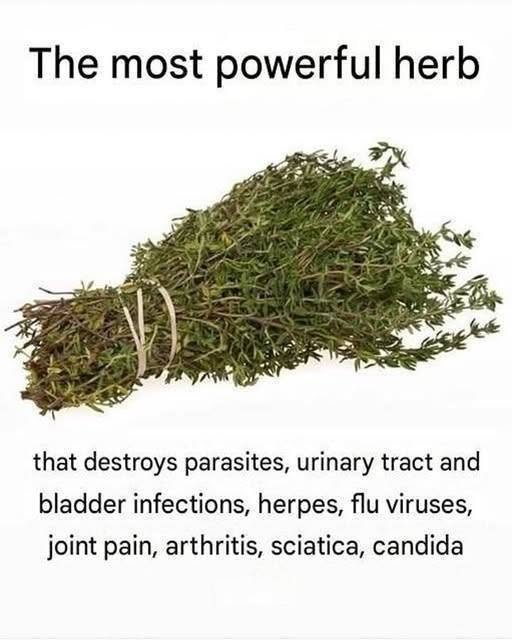
“The Most Potent Herb That Destroys Parasites, UTIs, Herpes, and Flu Viruses” — What’s the Truth?
Claims about a single “powerful herb” that can destroy parasites, cure urinary tract and bladder infections, eliminate herpes, and kill flu viruses are usually misleading.
Different infections are caused by different organisms, so there is no herb proven to safely and reliably cure all of these conditions.
🌿 What Herb Is Usually Being Promoted?
Viral posts making this claim often mention herbs inhibit an organism in a laboratory at a particular concentration, while the same concentration may be such as oregano, garlic, wormwood, cloves, or thyme, depending on the version of the post.
Some plant compounds have demonstrated antimicrobial or antiviral activity in laboratory studies. But activity in a test tube does not establish that consuming the plant will cure an infection in a person.
Laboratory evidence ≠ proven treatment
An extract may inhibit an organism in a laboratory at a particular concentration, while the same concentration may be impossible—or unsafe—to achieve in the human body.
1. Parasites
Parasitic infections vary enormously.
Some require specific antiparasitic medicines, and treatment depends on the particular parasite. A generalized herbal remedy can delay effective treatment or allow the infection to worsen.
If you suspect a parasite, proper testing and identification are much more useful than taking a broad “parasite cleanse.”
2. Urinary Tract and Bladder Infections
This is particularly important.
A bacterial UTI can sometimes progress from the bladder to the kidneys and potentially become a serious infection.
Symptoms can include:
- Burning when urinating
- Frequent or urgent urination
- Lower abdominal discomfort
- Cloudy or strong-smelling urine
- Blood in the urine
Fever, chills, back/flank pain, vomiting, or feeling seriously unwell can indicate a kidney infection and require prompt medical attention.
An herb should not be used as a substitute for appropriate evaluation and treatment of a suspected bacterial UTI.
3. Herpes
Herpes viruses remain in the body after infection. Current treatments can reduce the duration and severity of outbreaks and decrease transmission risk, but there isn’t an herb that has been proven to eradicate herpes from the body.
For recurrent genital herpes, clinicians may prescribe antiviral medicines such as acyclovir, valacyclovir, or famciclovir.
4. Influenza
Flu is caused by influenza viruses.
Some herbal ingredients have been studied for possible antiviral effects, but that doesn’t mean they can kill influenza virus inside a person’s body.
For people at higher risk of serious influenza complications, prescription antiviral treatment may be appropriate, particularly when started early.
Vaccination remains an important preventive measure.
⚠️ “Natural” Doesn’t Mean Risk-Free
Concentrated herbal products can cause side effects and interact with prescription medicines.
This is especially relevant if you take medicines for:
- Blood pressure
- Diabetes
- Blood clotting
- Heart disease
- Seizures
- Depression
- Other chronic conditions
Pregnant people, children, older adults, and people with kidney or liver disease should be particularly cautious about concentrated herbal preparations.
Don’t Put Herbal Oils Into Your Urinary Tract
Some online remedies recommend inserting oils, herbs, or homemade mixtures into the vagina or urethra to treat infections.
Don’t do this.
It can cause irritation, chemical injury, allergic reactions, or introduce additional infection.
The Safer Approach
Instead of asking “Which herb kills everything?”, first determine what you’re actually treating.
| Problem | Appropriate approach |
|---|---|
| Suspected UTI | Medical assessment/testing; appropriate treatment if bacterial |
| Suspected parasite | Identify the specific parasite and treat accordingly |
| Herpes outbreak | Evidence-based antiviral treatment when appropriate |
| Influenza | Supportive care and antivirals for eligible/high-risk people |
| Mild symptoms with uncertain cause | Evaluation rather than an unverified “cleanse” |
Bottom line
There is no scientifically established “most potent herb” that simultaneously cures parasites, UTIs, herpes, and influenza.
Some herbs contain interesting antimicrobial compounds and may have legitimate uses as foods or complementary products, but laboratory findings shouldn’t be presented as proof of a cure.
If you tell me which herb the claim is referring to, I can explain what research actually says about it, including its potential benefits, limitations, interactions, and safety.
